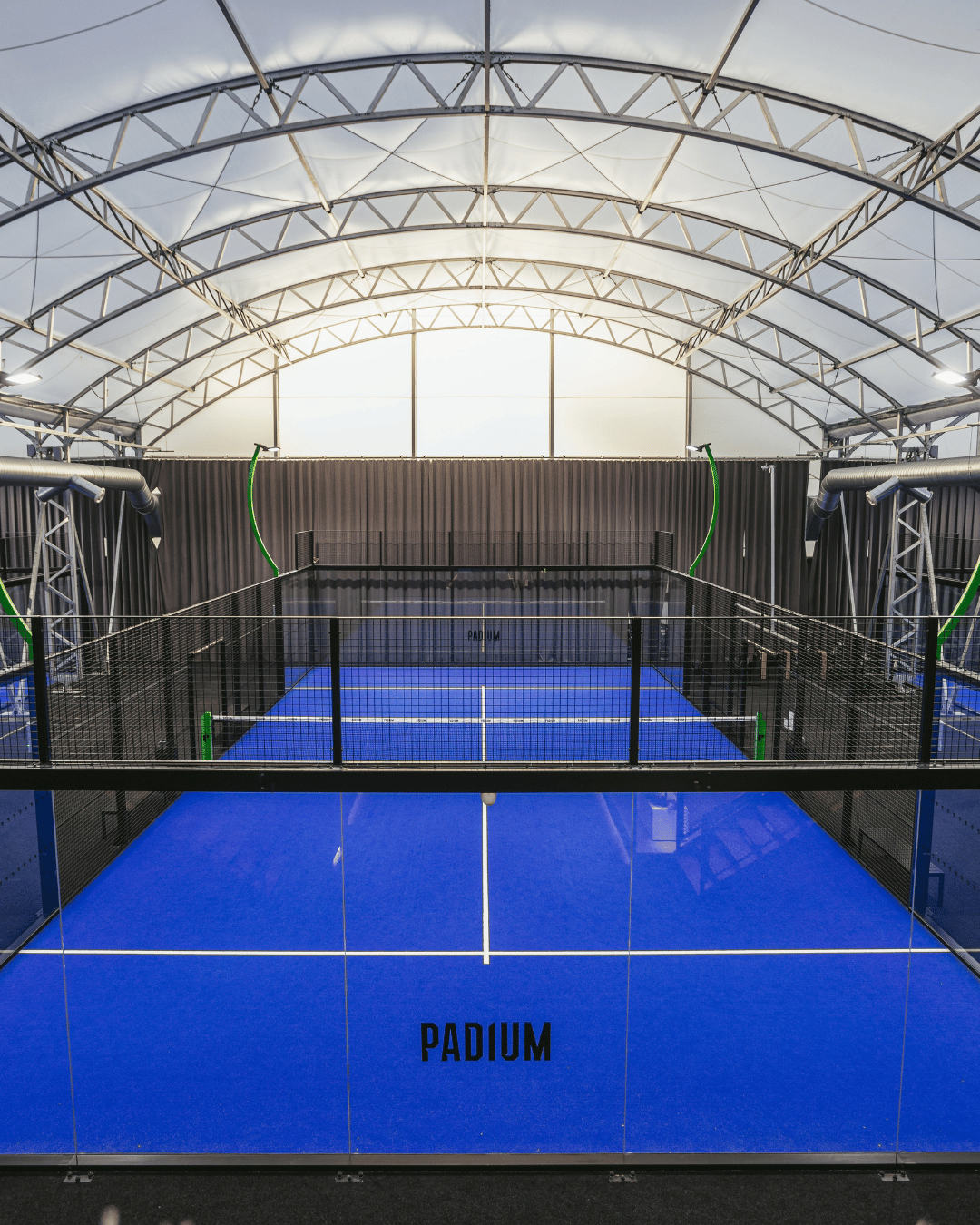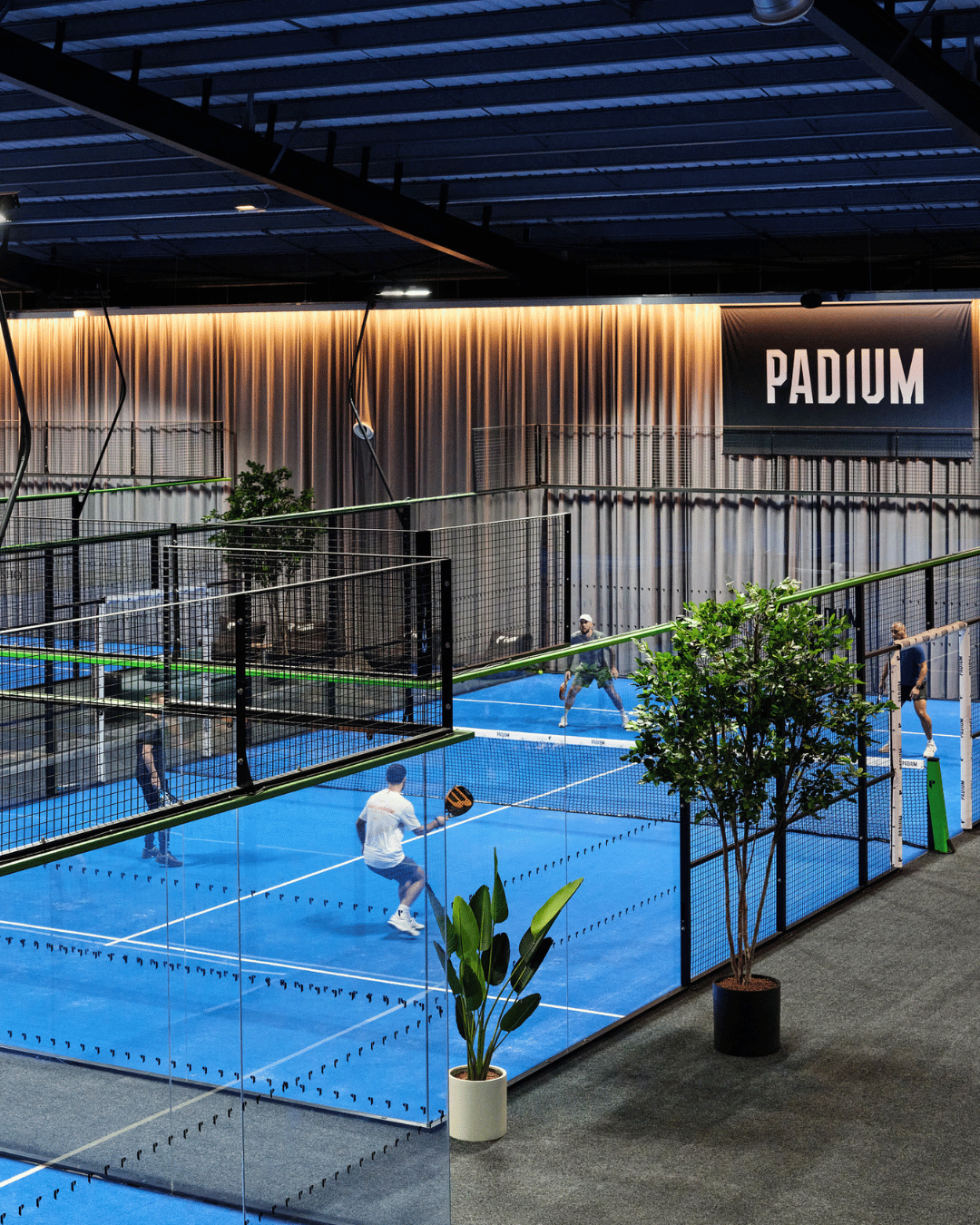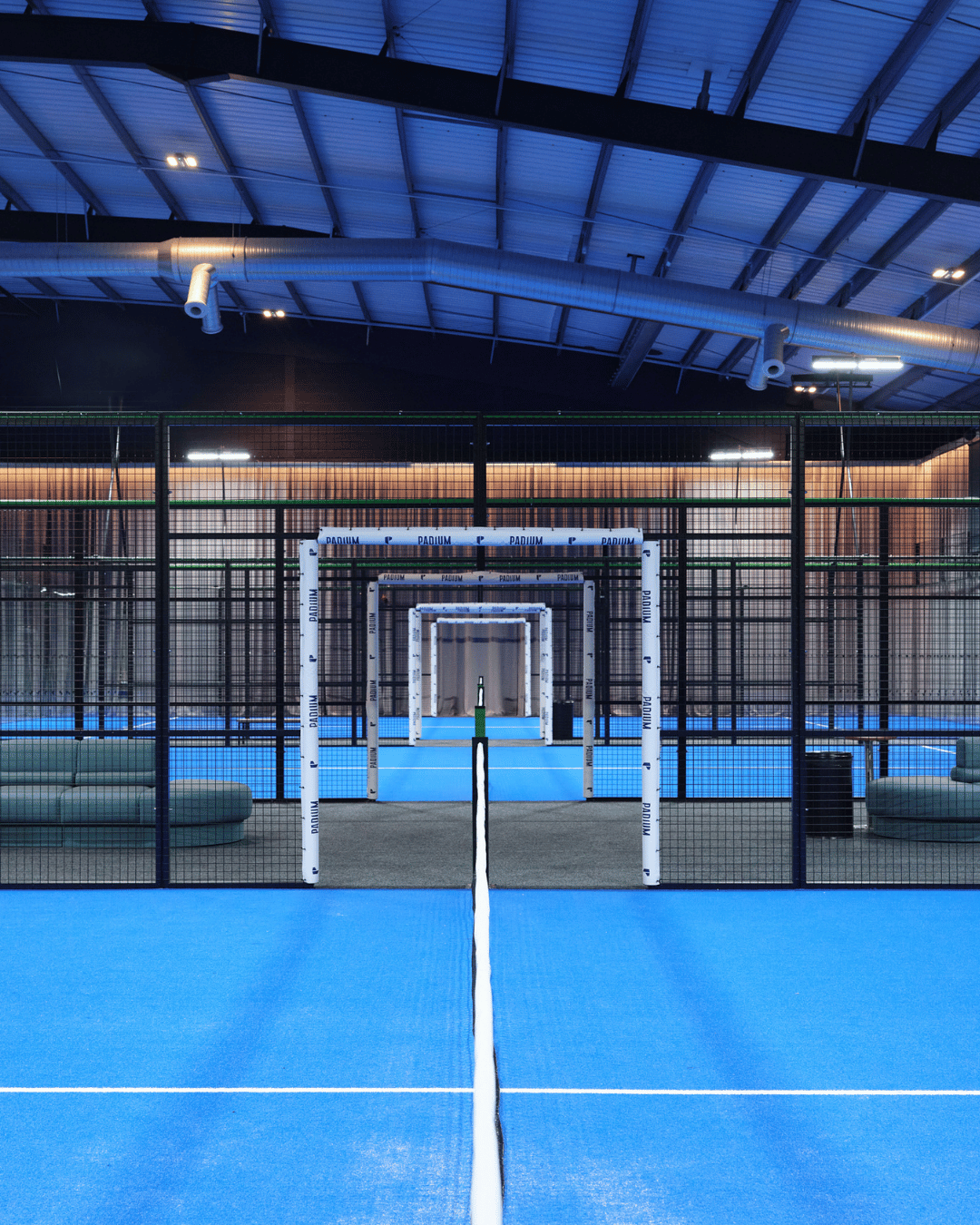
Understanding the padel court helps you play smarter and enjoy the game more. Here is a clear breakdown of every dimension, wall type and marking you need to know.
One of the things that makes padel immediately recognisable is the court itself. Enclosed by glass walls and metal mesh fencing, divided by a low net, and considerably more compact than a tennis court, it creates a playing environment unlike any other racket sport. The court is not just a container for the game. It is an active part of how padel is played, which is why understanding its layout and dimensions helps you become a better player much faster.
Whether you are booking your first game at Padium, designing a facility, or simply trying to understand why the ball keeps coming back off the glass, this guide covers everything you need to know about how a padel court is structured, measured and set up.

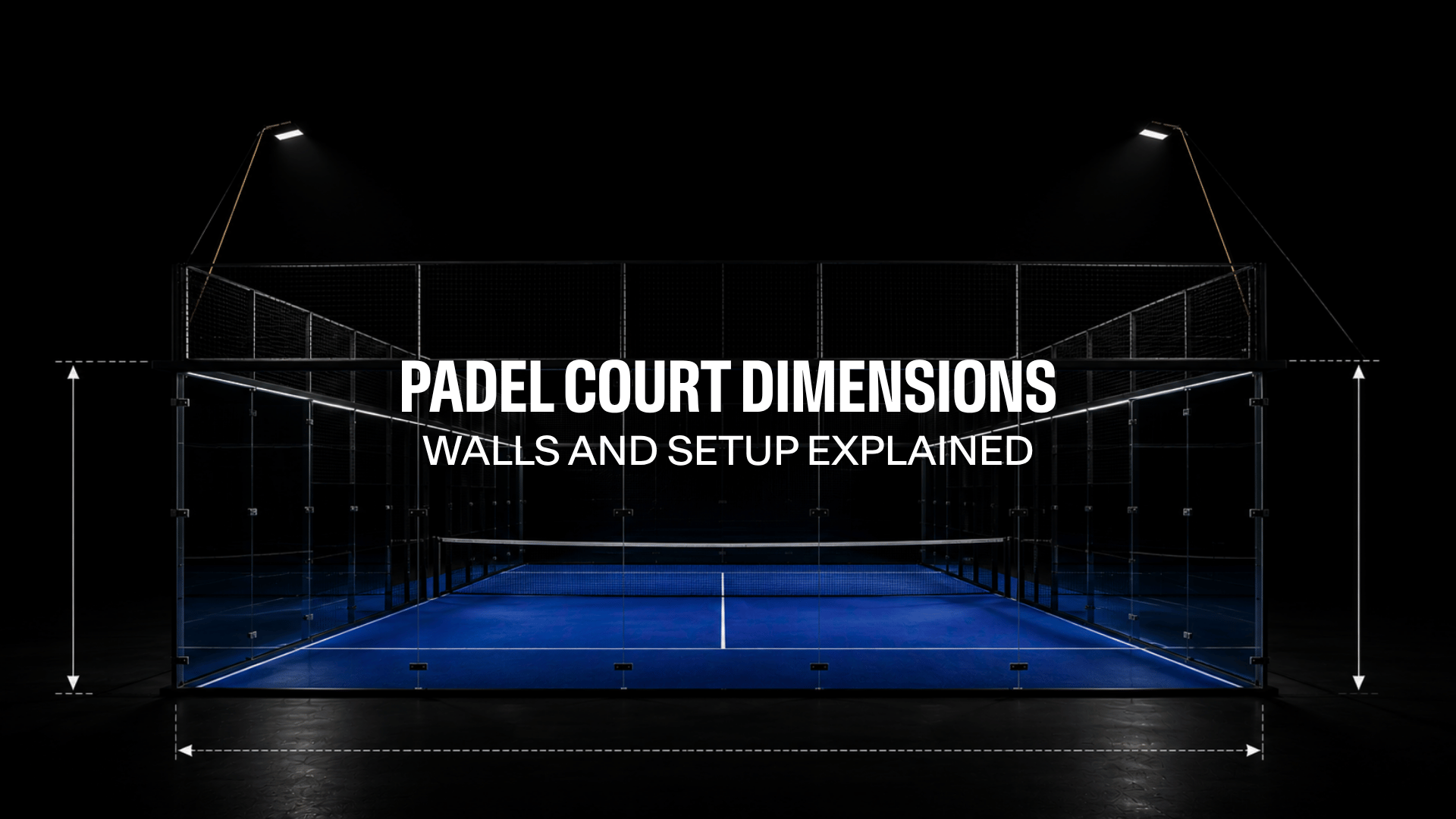
According to the International Padel Federation (FIP), the official governing body of the sport, a standard padel court measures 20 metres in length and 10 metres in width, with a permitted tolerance of 0.5 per cent in either direction. This applies to the interior playing surface, measured from the inside of the enclosing walls.
The total playing area is 200 square metres, which is roughly a third of the size of a full tennis court. That compact footprint is a significant part of Padel's appeal. The smaller space means more action per square metre, more time at the net, and a game that feels genuinely accessible even when you are just starting out.
The court is divided into two equal halves by a net, giving each team a playing zone of 10 metres by 10 metres.
For facilities planning a padel installation, the FIP also stipulates a minimum clearance around the court. Including safety zones behind the back walls and along the sides, the total footprint required for a single padel court is approximately 23 metres by 13 metres. This ensures players have adequate space to move outside the court when chasing balls through the doors.

The net runs the full 10-metre width of the court and sits at the centre, dividing the two halves evenly. It functions in the same way as a tennis net, with the natural curve that means it sits lower in the middle than at the posts.
The official FIP specifications set the net height at 88 centimetres at the centre and 92 centimetres at the posts. The net is held in place by a steel cable and has a white tape band along the top, between five and six centimetres wide. The mesh must be fine enough that the ball cannot pass through it.
For players coming from tennis, the padel net sits fractionally lower at centre, which shapes some of the tactical differences between the two sports. The slight height variation between centre and posts also means the angle of a crosscourt shot and a straight shot require different calculations, something that more experienced players use deliberately.

The lines on a padel court are relatively simple compared to tennis. All lines must be five centimetres wide and are painted in a contrasting colour to the court surface, typically white.
The most important marking for gameplay is the service line. According to FIP regulations, it runs parallel to the net at a distance of 6.95 metres from it on each side. This places it just over three metres from the back wall. The service line runs the full 10-metre width of the court.
The centre service line runs perpendicular to the net and divides the service area into two equal boxes, a left box and a right box. Each service box therefore measures 6.95 metres deep by five metres wide. The centre service line extends at least 20 centimetres beyond the service line toward the back wall.
When serving, the player stands behind the service line on the appropriate side of the court and plays the ball diagonally into the opposite service box. The first serve of a game is always from the right. After each point, the server switches sides.
The zone between the service line and the back wall, roughly three metres deep on each side, is the area where most of the game is played from the baseline. Understanding where this zone begins and ends helps players position themselves more efficiently, particularly when defending against lobs.

The walls are what make a padel court a padel court. They are the feature that most surprises new players and the feature that, once understood, transforms the experience of playing.
A standard padel court has four walls. The two back walls and the section of side wall closest to the back are made from tempered glass, typically ten to twelve millimetres thick. Tempered glass at this specification is robust enough to withstand high-velocity ball impacts while remaining transparent, which creates the visual experience of watching the game from outside the court and gives players visibility into the space behind them.
The remaining sections of the side walls, toward the net, are made from galvanised metal mesh fencing. The maximum mesh size permitted under FIP regulations is approximately six by six centimetres, and the fencing must be tensioned sufficiently to produce a predictable ball rebound.
The heights of these walls matter both structurally and in terms of gameplay. The back walls rise to four metres in total: the lower three metres are glass and the upper one metre is mesh fencing. The side walls have a stepped configuration. The section closest to the back wall, covering approximately the first four metres of the side wall, is four metres high. Moving toward the net, the side walls reduce to three metres in height for the remainder of their length.
This stepped wall profile is part of what creates the distinctive shape of a padel court and is one of the reasons that the game's wall play feels different at different positions on the court. A ball hit into the back glass close to the corner will behave differently to one played down the side wall toward the net end, and reading those rebounds is a skill that develops naturally with experience.
Each court has one or two symmetrically placed doors in the side walls, used for player entry and exit. In professional facilities, these doors are designed to be flush with the fence to minimise disruption to ball flight.
How the walls affect play
For anyone new to padel, the walls can feel disorienting at first. Balls that would be out of bounds in any other racket sport remain in play, and rallies continue in ways that take some adjustment.
The fundamental rule is straightforward: a ball must bounce on the ground first before contacting the back glass or side wall on your side. Once it has bounced, you can play the ball off the glass and it remains live. The glass walls on the back of the court produce a regular, predictable rebound because of their smooth surface. The mesh sections produce a softer, lower rebound due to the energy absorbed by the flexible fencing.
This difference in rebound character between glass and mesh is something players use tactically. A ball played into the back glass will come off more firmly and with more pace. A ball that hits the mesh, particularly higher up, tends to die more quickly, which can catch opponents off guard.
Understanding the walls does not take long. After a few sessions, the court starts to feel smaller and more manageable, and using the glass begins to feel natural.

The most common surface material for padel courts worldwide is artificial turf, and it is what you will find at the vast majority of clubs, including at Padium. According to the official FIP tournament specifications, the texturised monofilament artificial turf is the surface used for professional competition, including at Premier Padel events.
Artificial turf for padel is typically laid at a pile height of twelve to fifteen millimetres and infilled with silica sand. The sand infill stabilises the surface, controls the ball's bounce and contributes to the traction underfoot that allows players to slide, plant and change direction confidently. The surface is designed to absorb some impact, which is gentler on joints than harder court materials.
Court surfaces are available in several colours, with blue, green and terracotta being the most widely used. FIP regulations allow black for indoor courts but not for outdoor installations.
For indoor courts, FIP recommends a minimum ceiling clearance of six metres above the playing surface, with eight metres preferred for new builds. This clearance is essential for lobs, one of the most important defensive shots in Padel, to remain in play without hitting the ceiling.
Indoor vs. outdoor courts
Padel courts can be built outdoors, indoors, or as semi-covered structures. The court dimensions, wall specifications and surface standards remain the same regardless of whether the court is inside or outside.
The practical differences are primarily about surface treatment and playing conditions. Outdoor artificial turf is treated with UV stabilisers to prevent fading and fibre degradation over time. Indoor courts, protected from direct sunlight, may use slightly different turf specifications optimised for conditions under artificial lighting. The playing experience on a well-maintained surface in either setting is broadly comparable.
Weather is the main variable that outdoor courts contend with. Indoor courts at venues like Padium Canary Wharf and Padium Cardiff offer consistent playing conditions year-round, regardless of temperature, rainfall or fading light.
What this means for your game
Most players do not need to memorise every measurement before stepping onto court for the first time. But understanding the basics of how the court is structured helps in several practical ways.
Knowing where the service line sits helps you understand the serving and receiving rules immediately. Knowing how the walls are configured helps you anticipate ball behaviour rather than being surprised by it. And understanding the relationship between the service boxes and the back wall zone helps you make sense of why padel positioning, particularly that instinct to move forward with your partner when the opportunity arises, works the way it does.
The padel court is not a complicated environment. It is a well-designed one, and it rewards players who take a little time to understand it.
Play at Padium
At Padium Canary Wharf and Padium Cardiff, our courts are built and maintained to the highest standards. Whether you are stepping onto a padel court for the first time or you already play regularly and want to experience a premium club environment, the court is ready when you are.
Book a court via Padel Mates and see the setup for yourself.