Learn how to choose the best padel racket for your level, with a simple guide to racket shapes, weight, balance, materials and expert advice from Padium.
Choosing the right padel racket can make a big difference to how you feel on court. The right racket can help you play with more control, confidence and consistency, especially if you are still developing your technique or starting to play more regularly.
But with so many options available, it can be difficult to know where to start. Should you choose a round, teardrop or diamond-shaped racket? Is a lighter racket better? What does balance mean? And how much do materials really matter?
This guide explains how to choose a padel racket in a simple, practical way. Whether you are buying your first racket or upgrading from an entry-level one, these tips will help you understand what to look for before making a decision.
At Padium, our team can also advise you in-person in our Pro Shop, where you can explore different racket options, including our racket partner Babolat, and test selected rackets during your game.
Why choosing the right padel racket matters
A padel racket is not just about style or brand. It affects how the racket feels in your hand, how easy it is to control the ball, how much power you can generate and how forgiving the racket feels during rallies.
For beginner and intermediate players, the best padel racket is usually not the most advanced or powerful one. It is the racket that suits your current level and helps you enjoy the game while you improve.
A good racket should feel natural when you swing, give you enough control and support the way you are learning to play.
Padel racket shapes explained
One of the first things to understand when choosing a padel racket is the shape. Most rackets fall into three main categories: round, teardrop and diamond.
Each shape offers a different balance of control, power and forgiveness.
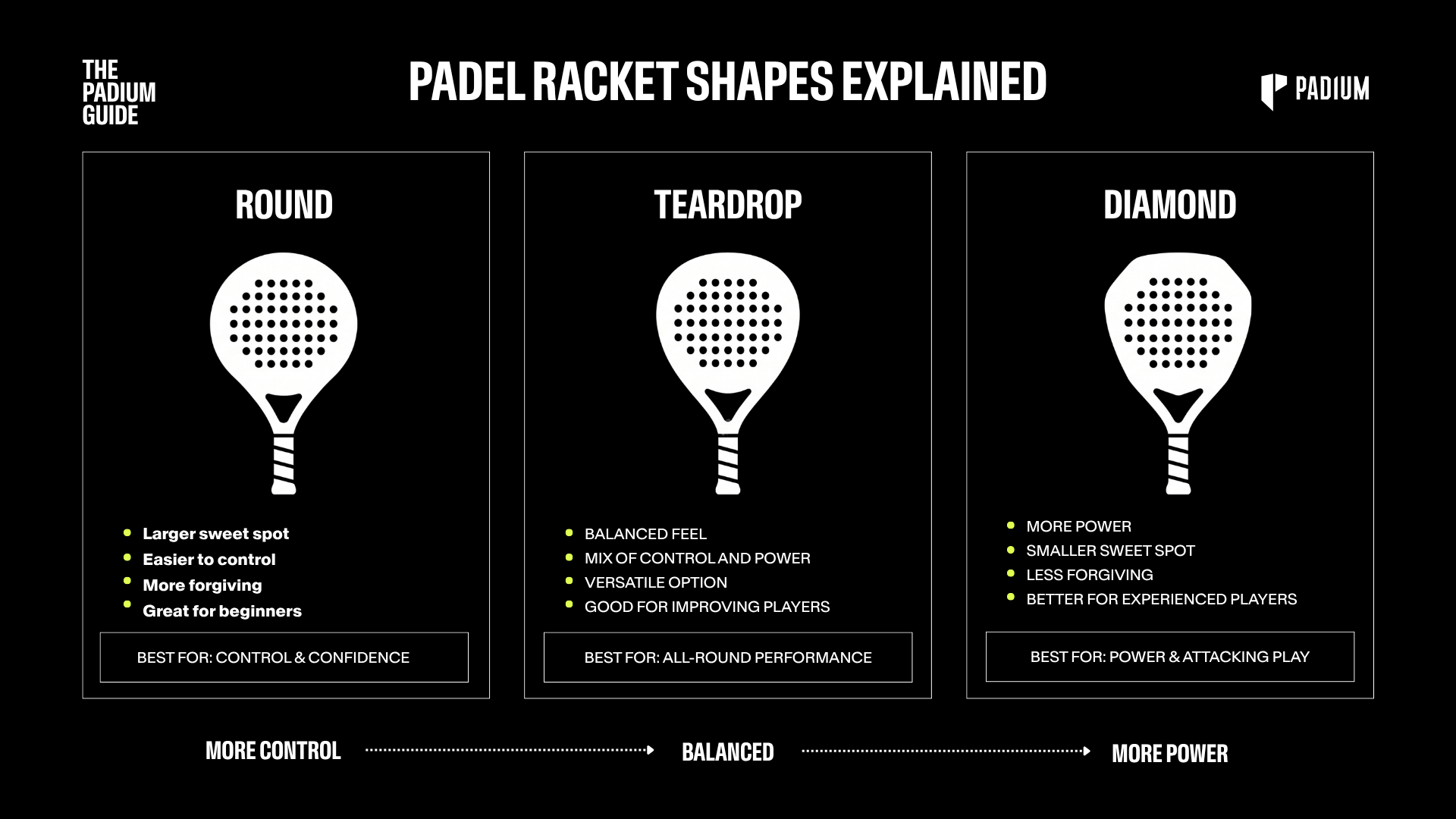

Round rackets are usually the most beginner-friendly option. They tend to have a larger sweet spot in the centre of the racket, which makes them easier to control.
They are often a great choice for players who are learning the game, building consistency or want a more forgiving feel.
Round rackets are usually best for:
- beginners buying their first padel racket
- players who want more control
- players still developing technique
- anyone who wants a more forgiving feel
Best for: control, consistency and confidence.

Teardrop rackets are often seen as the most balanced option. They usually offer a mix of control and power, making them popular with players who have moved beyond the beginner stage and want something more versatile.
The sweet spot is usually slightly higher than on a round racket, which can give a little more power without making the racket too difficult to use.
Teardrop rackets are usually best for:
- beginner to intermediate players
- regular players who want to improve
- players looking for a balance of control and power
- those who want a racket they can grow into
Best for: all-round performance.

Diamond-shaped rackets are usually designed for more power. The sweet spot is often higher on the racket face, which can help generate stronger attacking shots, especially overheads and smashes.
However, diamond rackets can be less forgiving and harder to control, especially for newer players. They often require better technique and timing.
Diamond rackets are usually best for:
- more experienced players
- players with strong technique
- players who want more power
- players comfortable with a smaller sweet spot
Best for: power and attacking play.
Think about racket weight
Racket weight is another important factor when choosing the best padel racket for your level.
Lighter rackets are usually easier to move, which can help with quick reactions, volleys and defensive shots. They can be a good choice for beginners or players who prefer a racket that feels easy to handle.
Heavier rackets can provide more stability and power, but they may feel harder to control if your technique is still developing.
As a simple guide:
- Lighter rackets feel easier to manoeuvre
- Medium-weight rackets offer a good balance
- Heavier rackets can provide more power and stability
For most beginner and intermediate players, a medium-weight racket is often a sensible starting point.
Understand racket balance
Balance describes where the weight of the racket is distributed. This affects how the racket feels when you swing it.
There are three main types of balance:
- Low balance - more weight towards the handle, usually easier to control
- Medium balance - a balanced feel between control and power
- High balance - more weight towards the top of the racket, usually more powerful but harder to handle
For most newer players, low to medium balance is usually the safest and most practical choice. It supports control and helps you feel more confident during rallies.
Know the basic racket materials
Padel rackets can be made with different materials, and these materials affect the feel of the racket.
Two common surface materials are fibreglass and carbon.
Fibreglass rackets usually feel softer and more flexible. They can be more forgiving, which makes them a popular choice for newer players.
Carbon rackets usually feel firmer and more responsive. They can offer more precision and power, but may feel less forgiving if your timing is not consistent yet.
Inside the racket, the core is often made from foam or EVA rubber. Softer cores can feel easier to play with, while harder cores usually provide a more direct and powerful response.
Choose a racket based on your level
The best padel racket for you depends on your experience and confidence on court.

If you are a beginner, look for a racket that gives you control, forgiveness and an easy feel. A round racket with a larger sweet spot is often the best place to start.
Beginners should usually prioritise:
- control
- easy handling
- forgiving feel
- low to medium balance
- round shape

If you already play regularly and want to improve, you may be ready for a racket with a little more performance. A round or teardrop racket can be a good option because it offers control with a little more power.
Beginner to intermediate players may want:
- Round or teardrop shape.
- Medium weight.
- Medium balance.
- More response.
- Enough control for longer rallies.

If you are more confident with your technique, you may want a racket that gives you more power, precision or response. Some players at this level may start exploring firmer materials, higher balance or more attacking racket shapes.
However, it is still important not to choose a racket that is too demanding. A racket should support your game, not make every shot harder.
Try before you buy at Padium
One of the best ways to choose a padel racket is to test it on court. A racket can look perfect online, but the real test is how it feels during rallies, volleys, serves and rebounds off the glass.
At Padium, players can visit our Pro Shop and speak to the team for advice before buying. You can explore different racket options, including selected Babolat padel rackets, and test some rackets during your game.
This is especially helpful if you are deciding between shapes, weights or levels. Sometimes the racket you expect to like is not the one that feels the best once you start playing.
At Padium Canary Wharf and Padium Cardiff, our team can help guide players towards a racket that feels right for their game, whether they are buying their first racket or upgrading as they improve.
Final thoughts
Choosing the best padel racket does not need to feel complicated. Start with the basics: your level, the racket shape, weight, balance and materials. For most beginners and intermediate players, control and confidence on court are more important than choosing the most powerful option.
A good racket should help you play with more consistency, make cleaner contact with the ball and enjoy the game more. As your padel improves, your racket preferences may develop too.
If you are unsure where to start, try different options, ask for advice and see how the racket feels during a real game.
Book a court at Padium Canary Wharf or Padium Cardiff and practice with the right racket.